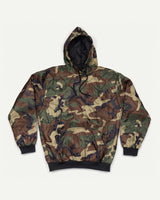
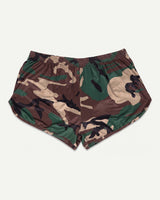
Before the spots
West Germany's new army, the Bundeswehr, was founded in late 1955, and its first field uniform used a splinter camouflage descended from the prewar German army's. It did not last. In 1959 the army switched to a single-color suit in line with other NATO armies, made with an early synthetic membrane that crackled and itched so much that troops nicknamed it the "Filzlaus," the crab louse. A plain olive field uniform followed in the mid-1960s, moved to moleskin fabric in the early 1970s, and stayed in service until the late 1990s.
Troop Trial 76
In 1976 the Bundeswehr ran a troop trial, Truppenversuch 76, to find a camouflage to replace the olive uniform. The German firm Marquardt & Schulz designed the candidates, at least four of them, each based on something in nature: a pattern of dots, a ragged-edged leaf pattern, a winter pattern based on pine needles, and a large-spot design called Flecktarn B. The idea of building camouflage from spots was not new in Germany. Its roots go back to German camouflage work of the 1930s, including a plane-tree leaf pattern drawn in 1936.
Flecktarn B came out ahead, but the army did not buy it, citing cost. The olive uniform carried on through the 1980s while testing continued.
Neighbors went first
Other armies moved faster. Denmark tested a Flecktarn-based uniform in 1978 and in 1984 adopted its own version, M/84, using the same shapes cut down to three colors to match Danish woodland. Belgium's air force put its base security troops in the German pattern from 1988, almost three years ahead of the Bundeswehr, and kept it until 2000. Japan's Self-Defense Forces fielded a four-color pattern clearly modeled on it.
Kampfanzug 90
After more trials in the late 1980s, the Bundeswehr finally chose Flecktarn B for a new uniform program called Kampfanzug 90, Battle Dress 90. The new field uniform reached troops gradually from 1990 and 1991, in a newly reunited Germany. Its official name says exactly what it is: Fünffarb-Tarndruck, five-color camouflage print. The mix is set down exactly, at 35 percent dark green, 20 percent grey-green, 20 percent brown, 15 percent light green and 10 percent black.
The pattern is controlled by the Bundeswehr's technical delivery conditions, its version of a military specification, and printed fabric needs an export permit. It has been revised several times. Since around 2005 the colors have been printed lighter and better separated, with a more rust-like brown and a sharper black. A three-color desert version followed in 1993 for German troops sent to Somalia and was later worn in Afghanistan. Collectors call it Wüstentarn, or loosely Tropentarn, though strictly Tropentarn is the five-color print on lighter fabric for hot climates.
What comes next
In 2016 Germany's defense materials institute tested Multitarn, a six-color pattern that adds beige, grey and off-white, and it went first to special forces. Reports since 2025 say Germany is moving its whole force to Multitarn, with the change due to finish by 2029. Flecktarn will outlast that on the many armies and police forces, from Poland to China, that have worn copies of it. For an older German pattern with a softer look, see Sumpftarn, and for all six patterns side by side, our camo patterns guide.



 Sold out