Skip to content
Woodland Woobie Hoodie, fabric close-up
Home › Guides › Camo patterns

Woodland camo

United States, 1981

Woodland is the four-color camouflage pattern the U.S. military adopted in 1981 for its Battle Dress Uniform, which is why collectors call it M81. It is a scaled-up, darker version of the Vietnam-era ERDL pattern, built from large light green, dark green, brown and black shapes. It was the main U.S. combat pattern for more than twenty years.

Shop Woodland

Shop Woodland

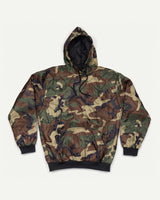
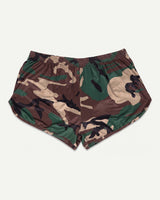
Our Woodland print keeps the big four-color shapes of the original, with the light green sitting as a warm sand, and the quilting runs over it in the wavy lines of a poncho liner. It's the one camo on every product we make, so a full set can match: the Blanket and zip-up Blanket 2.0, the Poncho they tie into, the Hoodie, both the Jacket and Jacket 2.0, and Silkies. On the Hoodie, the hood and interior lining are moving from Woodland to solid black, and depending on stock yours may arrive with either.

The story of Woodland

A 1948 leaf pattern

Woodland starts with a four-color pattern drawn in 1948 at the U.S. Army Engineer Research and Development Laboratories, the source of the name ERDL. The Army tested it against plain olive and other camouflage in 1962 but kept plain uniforms for general use. In Vietnam it finally went into service from 1967 on tropical combat uniforms, first for Special Forces and reconnaissance teams. The first Vietnam version was bright, with lime green leaf shapes, so Natick Labs toned it down into a brown-dominant version in late 1967 and 1968. By the end of 1970 all the services were wearing ERDL, and it had pushed aside Tiger Stripe in many of the reconnaissance outfits that had made that pattern famous.

Scaled up for a different war

After Vietnam the Army's planning turned to Europe, where fighting in woodland was expected at longer ranges. ERDL's small shapes had been drawn for close-range fighting in jungle. Trials in 1975 printed the pattern at four scales: the original, and enlarged by 30, 60 and 100 percent. The 60 percent version did the job, and it became Woodland. Natick engineers Alvin Ramsley and William Bushnell wrote up the work in a January 1981 report. The aim was a pattern that still broke up a soldier's outline out to about 350 meters.

The colors were set as four Army shades, numbered 354 to 357: light green, dark green, brown and black. Woodland was printed a touch darker than ERDL on purpose, so that washing and sun would fade it toward the intended shades rather than past them.

The BDU years

The Army approved the requirement for a new camouflage field uniform in June 1979, and soldiers received their first Woodland BDUs on October 1, 1981. That first uniform was a heavy 50/50 nylon and cotton twill with reinforced knees, elbows and seat. It proved too heavy for the tropics: troops in Grenada in 1983 complained about it, and by March 1984 the Army was testing a lighter version. A hot weather BDU in cotton ripstop followed, and the uniform went through three cuts, in 1981, 1984 and 1989.

Woodland soon covered far more than shirts and trousers. It went onto cold weather parkas, Gore-Tex shells, chemical protective suits, vests, pack covers and the poncho liner, so a soldier of the 1980s and 1990s could be in Woodland from head to sleeping gear. You can read the liner's side of the story on our What is a woobie? page.

Retired, and still around

The digital patterns of the 2000s ended Woodland's run. The Marines finished their changeover by October 2004, the Army formally retired the BDU in April 2008, and the Air Force dropped Woodland in 2011. It never quite went away. Marine special operations forces went back to a Woodland uniform in 2011, some state defense forces still wear it, and some 50 countries and armed groups have worn Woodland or close copies of it, from South Korea's own version, adopted in 1990, to the copies made for Russia's interior ministry troops.

That long run is why it is the pattern so many veterans picture when they think of their own kit. For a quick comparison with the other patterns we make, see our camo patterns guide.

“My woodland hoody has been a great addition. I have worn it as a wind blocking shell, an insulating layer and a cover for light rain.”

Allen, The Woobie Hoodie Verified buyer

Woodland Woobie Hoodie, hood
Woodland Woobie Hoodie, folded
Woodland Woobie Hoodie, cuff and hem
Woodland Woobie Hoodie, side view

How to spot Woodland

Woodland is all big, rounded shapes in four colors, with black laid over the top. From a distance it reads as a dark green and brown forest.

  • Four colors and only four: light green (it often reads as sand or khaki), dark green, brown and black.
  • Large shapes with smooth, rounded edges. There are no dots, stripes or square pixels.
  • Next to ERDL, everything is bigger and darker. ERDL's leaf shapes are smaller and busier, and early ERDL has bright lime green in it.
  • Next to MARPAT or the Army's UCP, the difference is the edges: those digital patterns are built from tiny squares.
  • Next to Tiger Stripe, Woodland has blotches where Tiger Stripe has long sideways strokes.

Woodland questions

Sources
  • omegamilitaria.com ERDL four-color pattern developed c.1948 at USAERDL; 1962 stateside trial, not adopted for general service; Vietnam TCU orders 1967, first deliveries Dec 1967; green-dominant version too bright, Natick brown-dominant version late 1967 to early 1968; all branches wearing ERDL by end of 1970
  • en.wikipedia.org ERDL developed by the Army's Engineer Research & Development Laboratories in 1948, worn in Vietnam from 1967
  • en.wikipedia.org ERDL gradually replaced Tiger Stripe in reconnaissance units
  • omegamilitaria.com 1975 MASSTER Phase II tested expansion series at 0, 30, 60 and 100 percent; the 60 percent version performed best and became Woodland; Woodland printed slightly darker so fading brings it toward target shade; three cuts 1981, 1984, 1989; hot weather cotton ripstop poplin 1984
  • ciehub.info Woodland is a 60 percent expansion of the 1948 four-color pattern, to extend effectiveness to about 350 meters; shades Light Green 354, Dark Green 355, Brown 356, Black 357; Ramsley and Bushnell, Development of the U.S. Woodland Battle Dress Uniform, NATICK/TR-81/008, January 1981; related items include poncho liner, ECWCS parka, ALICE pack covers
  • apps.dtic.mil Natick technical report on the development of the Woodland BDU (Ramsley and Bushnell, 1981)
  • en.wikipedia.org Enlargement reflected the shift from close-range Vietnam fighting to longer-range fighting in European woodland; four-color green, brown, sand and black; M81 nickname from adoption year, never official; MARSOC reintroduced Woodland in 2011; Air Force phased it out in 2011; around 50 countries and groups listed as users, including South Korea's Tonghab version adopted 1990 and Russian MVD copies; state defense forces such as the Virginia Defense Force
  • en.wikipedia.org BDU requirement approved 25 June 1979; soldiers first received temperate-weight BDU on 1 October 1981; 50/50 nylon-cotton twill with reinforced knees, elbows and seat; troops (Grenada) complained it was too heavy for tropical environments; tropical-weight variant under evaluation by March 1984; Marines' changeover complete by 1 October 2004; Army replacement late 2005 to early 2008, BDU formally discontinued April 2008

Net Orders Checkout

Item Price Qty Total
Subtotal $0.00
Shipping
Total

Shipping Address

Shipping Methods