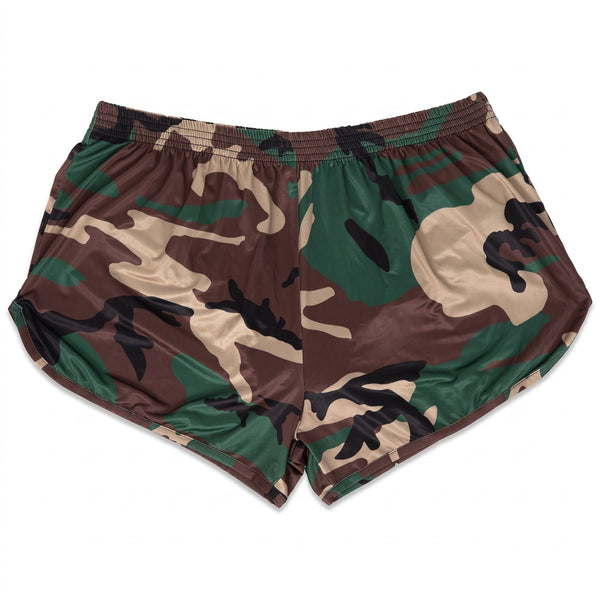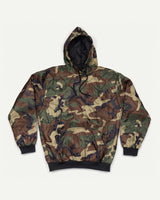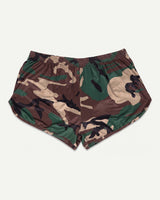

Every camo print we use is named after a pattern that soldiers actually wore, from the jungles of Vietnam to the forests of Central Europe and the desert of the Gulf War. Each print takes its look from the pattern it's named after. Below is where each one came from, what it looks like up close, and which woobies you can get it on.
One naming note before you shop: the Woobie Jacket and Jacket 2.0 list it as Desert Night Camo, and the Woobie Hoodie lists it as Desert Night. It's the same pattern.
Every pattern at a glance
| Pattern | Origin | Era | Woobie products |
|---|---|---|---|
| Woodland | United States | 1981 into the 2000s | All seven: Hoodie, Jacket, Jacket 2.0, Blanket, Blanket 2.0, Poncho, Silkies |
| Tiger Stripe | South Vietnam, worn by U.S. Special Forces | Early 1960s, Vietnam War | Hoodie, Jacket, Jacket 2.0, Silkies |
| Flecktarn | West Germany | Designed 1976, widely worn from 1990 | Hoodie, Jacket, Jacket 2.0 |
| Sumpftarn | Germany | 1943, then West Germany's border guard in the early 1950s | Hoodie |
| Chocolate Chip | United States | 1981 to around 1995, Gulf War | Hoodie |
| Desert Night | United States | Tested in the 1970s, Gulf War 1990 to 1991 | Hoodie, Jacket, Jacket 2.0 |
| Black, Ranger Green, Coyote Tan | Solid colors | Ranger Green from the early 2000s | See below |
Woodland
Woodland is the pattern many people picture when they think of a poncho liner. It's a four-color, high-contrast print of green, brown, sand and black, in big interlocking shapes with black branch-like strokes over the top.
The U.S. military adopted it in 1981, which is why collectors call it M81, a name the military itself never officially used. It was an enlarged, slightly altered version of the older ERDL pattern from the Vietnam War, printed darker and with more contrast. Woodland stayed on uniforms for more than two decades. The Marines moved to digital MARPAT in 2002 and the Army to its Universal Camouflage Pattern in 2005.
Poncho liners followed the same path. The first liners, fielded to Special Forces in Vietnam around 1962, were plain olive drab. Camouflage versions came next, and Woodland liners arrived in the late 1980s. You can read more of that story on our What is a woobie? page.
Woobie products in Woodland: every one of them. The Hoodie, Jacket, Jacket 2.0, Blanket, Blanket 2.0, Poncho and Silkies. One detail on the Hoodie: we're switching the hood and interior lining on Woodland from pattern to solid black, so depending on stock yours may come with either.
More on Woodland: the full Woodland story, how to spot it and every Woodland piece we make.
Tiger Stripe
Tiger Stripe is made of narrow green and brown stripes that look like brushstrokes, with broader black strokes printed over a lighter olive or khaki base. The stripes run sideways and interlock, which breaks up an outline in dense brush at close range.
Nobody is sure who drew the first version. It was developed by South Vietnamese forces for close-range jungle fighting, and it apparently grew out of the French "lizard" pattern. U.S. Special Forces took it up in late 1962 to early 1963, and many other American special operations troops in Vietnam soon wore it too. Tiger Stripe was never an official U.S. uniform pattern. Americans often had their uniforms made locally, which is part of why so many versions exist.
It's also the pattern that gets noticed. Dan G. said this about his hoodie: "I get compliments on my tiger stripe hoodie wherever I go."
Woobie products in Tiger Stripe: the Hoodie, Jacket, Jacket 2.0 and Silkies. As with Woodland, Tiger Stripe hoodies may arrive with a patterned or a solid black lining.
More on Tiger Stripe: the full Tiger Stripe story, how to spot it and every Tiger Stripe piece we make.
Flecktarn
Flecktarn means "mottled camouflage" in German, and that's what it looks like: small dots and flecks of dark green, grey-green, red-brown and black over a lighter base. From a few steps back the dots blur together into the light and shadow of a forest floor.
The German firm Marquardt & Schulz designed it in 1976, when the West German army was testing new patterns. At least four were tried, and the one called Flecktarn B was chosen as the most effective for Central European terrain. It only went into wide use in 1990, in a newly reunited Germany.
Aaron S., who bought the Hoodie in Flecktarn, said it simply: "the Flecktarn looks awesome!"
Woobie products in Flecktarn: the Hoodie, Jacket and Jacket 2.0.
More on Flecktarn: the full Flecktarn story, how to spot it and every Flecktarn piece we make.
Sumpftarn
Sumpftarn translates as "swamp" or "marsh" camouflage. Ours has a sandy base with soft-edged green and brown shapes, red-brown spots and fine streaks running through it. It looks softer and more washed out than Flecktarn.
The pattern goes back to 1943, when it was first used by German Wehrmacht units in World War II as a blurred, greener take on the older splinter pattern. After the war, West Germany's federal border guard, the Bundesgrenzschutz, used a modified version in the early 1950s. In the war it was made as smocks, helmet covers and winter overpants.
Woobie products in Sumpftarn: the Hoodie only.
More on Sumpftarn: the full Sumpftarn story, how to spot it and every Sumpftarn piece we make.
Chocolate Chip
Chocolate Chip is the U.S. six-color desert pattern. It has a sandy base with large brown and pale shapes, dotted with small black and white clusters that look like chocolate chips in cookie dough, which is how it got the nickname.
It was developed for desert use and came in with the Desert Battle Dress Uniform, first handed out in 1981. Its big moment was the Gulf War of 1990 to 1991. A replacement three-color pattern had been approved in 1990 but wasn't ready in time, so U.S. troops went to war in Chocolate Chip. It was phased out in the early to mid 1990s, with the last services dropping it around 1995.
Woobie products in Chocolate Chip: the Hoodie only.
More on Chocolate Chip: the full Chocolate Chip story, how to spot it and every Chocolate Chip piece we make.
Desert Night
Desert Night is the oddest-looking pattern in our range. It's a light green base covered in a grid of darker green dots, with scattered darker shapes printed over the grid. It looks nothing like the ground around it, and that was never the point.
The U.S. military designed it to help hide soldiers from Soviet-made night vision devices. Field tests took place in 1976 and limited use began in 1981. It was worn in wider numbers during the Gulf War of 1990 to 1991, usually as a parka and overpants over the Chocolate Chip desert uniform at night. Better night vision technology made it obsolete soon after, so it's one of the rarer patterns you'll see.
Woobie products in Desert Night: the Hoodie (listed as Desert Night), and the Jacket and Jacket 2.0 (listed as Desert Night Camo).
More on Desert Night: the full Desert Night story, how to spot it and every Desert Night piece we make.
Black, Ranger Green and Coyote Tan
If camo isn't your thing, three solid colors cover the rest of the range.
Ranger Green
Ranger Green is a darker, cooler green than classic olive drab, with grey undertones. It grew out of U.S. Army special operations requirements in the early 2000s and was designed for darker, shadowed places. It's on all seven Woobie products: Hoodie, Jacket, Jacket 2.0, Blanket, Blanket 2.0, Poncho and Silkies.
More on Ranger Green: the full Ranger Green story, how to spot it and every Ranger Green piece we make.
Coyote Tan
Coyote is a light brown that works in dry country and goes with almost everything. The Marine Corps even fielded a reversible poncho liner with camo on one side and solid coyote on the other. You'll find Coyote Tan on the Hoodie, the Jacket, both Blankets, the Poncho and Silkies.
More on Coyote Tan: the full Coyote Tan story, how to spot it and every Coyote Tan piece we make.
Black
Black is the one that looks at home in town. It comes on the Hoodie, the Jacket, the Jacket 2.0 and Silkies.
More on Black: night raids, the SAS at Princes Gate and how black really works after dark.
How to pick a pattern
- For the classic woobie look: Woodland. It's the pattern many veterans remember from their own liners, and it's on everything we make.
- For something people ask about: Tiger Stripe, Flecktarn, Sumpftarn or Desert Night.
- For a matching set: Woodland or Ranger Green, the only two that run across every product, so a hoodie, a blanket and a pair of Silkies can all match.
- For everyday wear with jeans: Black, Ranger Green or Coyote Tan.
Whatever you pick, the build stays the same (our materials page goes through every layer). The Jackets use the same lightweight insulating material as the blanket, and the Hoodie is built the same way with a softer, lighter nylon shell. Sizing is on our size guide, and if you're between sizes on a hoodie or jacket, size down.